
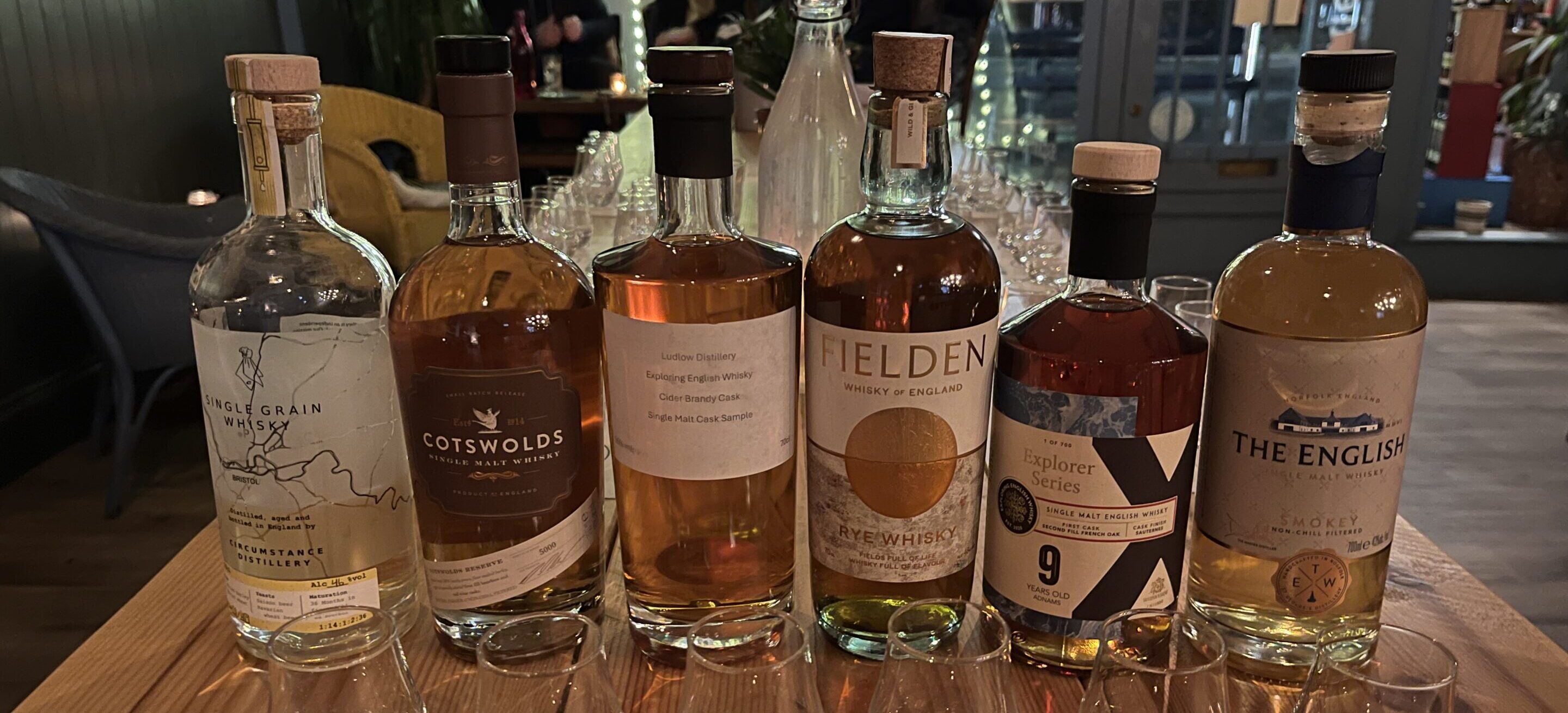

We haven’t written about the English Whisky GI yet. Partly because almost everyone else has – but also because we wanted to fully understand what the implications are for you, English Whisky consumers, rather than for the industry at large. Here is our best effort at doing just that!
What is a Geographic Indication (GI) ?
A GI is an intellectual property right that protects the names of food, drink, and agricultural products that have specific qualities, characteristics, or a reputation linked to their place of origin.
You can read the full English Whisky GI here:
But in essence the main rules are:
- UK grown grains and English water (Stricter than Scottish, Welsh and Irish GIs)
- Mashing, fermentation, distillation and ageing to take place in England
- The usual 3 years+ maturation and 40% or above ABV when bottled
- However, any wood (not just oak) can be used for maturation
- Stills can be hybrid pot-column rather than just pot or column
Specifically for SINGLE MALT English Whisky:
- Wash can be brewed off site (e.g. a brewery)
- Must be distilled at least twice at a single site (but can be on a hybrid still)
- Stills must contain “sufficient copper contact”… explanation below:
“To be classed as Malt English Whisky the spirit needs to be batch distilled (not continuous distilled) and at least one distillation in a pot still (note it can be in conjunction with a column) with sufficient copper contact in the vapour path (to support the removal of undesirable compounds and promote the formation of esters and other aromatic compounds).
“Sufficient copper contact in the vapour path” means that during distillation, spirit vapour must come into direct contact with exposed copper surfaces — such as the pot still head, lyne arm, packed copper columns, copper waffles, dephlegmator, or internal column plates. Note: non-functional copper components (such as small fastenings, fittings, bolts, screws, or decorative elements) do not constitute “sufficient copper contact”.
English whisky can also be bottled outside of England but can only be transported outside of England in inert containers (so maturation is stopped).
6 Years In The Making
Just like a good whisky, this has been developing for many years. Whilst the original draft was submitted in 2022, the English Whisky Guild (and in particular, its now Chair, Tagore Ramoutar) began drafting it as early as 2020. Defra sat on it for almost 3 years before publishing it in 2025, after which a 3 month period of public consultation / opposition allowed the likes of Circumstance Distillery, Spirit of Birmingham and the SWA to lodge objections. A subsequent consultation phase until around October 2025 occurred, based on valid objections from the aforementioned.
None of the formal objections changed the outcome and so the GI was finally approved in September and came into force on 1 October. However, the story is not yet over as all 3 original objectors have appealed within a 3 month window after publication(along with the Welsh and Irish whisky association lending their names to the SWA appeal) and will now have their objections heard by an independent tribunal – the General Regulatory Chamber. This will be the first time either the original submission, objections or ministerial decisions will be scrutinised by judges rather than distillers, the Guild, Ministers and civil servants. It will be interesting to see how they view the appeals and whether any will be upheld.
The Shelf Test
When you make a spirit (or any drink for that matter), ‘The Shelf Test’ is how your product looks and stands out on a shop shelf. Currently, most retailers group English Whiskies together in their “English Whisky” section, but how will the GI impact labelling (and will retailers need to adapt?)
The GI scheme is voluntary – that is to say only distilleries who choose to register (and are subsequently verified as being compliant) can use the term “English Whisk(e)y”. Anyone who doesn’t register falls back on ‘Assimilated Regulation (EU) 2019/787’ – essentially EU law we incorporated into UK law when we left the EU.
This raises a few potential differences on English Whisky bottles (based on our understanding):
- Single Malt “English Whisky” – verified distillery, compliant production, can use GI
- Single Malt Whisky – verified distillery, compliant, choose not to use GI
- Single Malt Whisky – unverified distillery, compliant production, cannot use GI
- Single Malt Whisky – unverified distillery, uncompliant production, cannot use GI
Immediately there’s an issue here. Can retailers place unverified products in their “English Whisky” sections, if the products themselves are unable to use that same term? How do you differentiate between GI compliant and non compliant “Single Malt” when distilleries choose not to verify ( considering there’s a cost involved some may choose not to – even if in theory they could).
It all gets rather muddy once this hits the shelves (which isn’t yet as there will be a window for distilleries to apply for verification and be inspected, and even then some products may be granted ‘grandfather rights’ until such time as they’re sold out or a set time limit is reached) to allow for changes to their labels.
In Conclusion
Unlike in Scotland where the Scotch Whisky Regulations Act 2009 mandates that ALL whisky made in Scotland must be made in a certain way, the English GI is essentially optional for English distillers. Whilst there will now be some clarity over the term “English Whisky” (be it grain, malt or single malt), there is still potential confusion over bottles made in England that don’t use that word (or others related to their origin, e.g. well known English place names). Internationally it will likely be a different matter with all verified brands able to export using the term which will likely provide clarity in the global whisky market, as only the largest tend to ship product outside the UK (for now).
So, as always, enjoy what’s in your glass wherever it’s made across England and keep supporting your local distillery, retailer and bars who stock the amazing array of English whiskies on offer. We will continue to celebrate all whisky made in England, whether it says ‘England’ on the bottle or not and hope that the GI doesn’t unintentionally complicate matters for consumers and retailers once the distillery verification process has occurred and the new labelling comes into force.
Cheers,
Richard


